Downton Abbey is a British period drama television series created by Julian Fellowes and co-produced by Carnival Films and Masterpiece.[1] It first aired on ITV in the United Kingdom and Ireland on 26 September 2010 and on PBS in the United States on 9 January 2011 as part of the Masterpiece Classic anthology. Four series have been made so far; a fifth is planned for 2014.
Downton Abbey has received critical acclaim from television critics and won numerous accolades, including a Golden Globe Award for Best Miniseries or Television Film and a Primetime Emmy Award for Outstanding Miniseries or Movie. It was recognised by Guinness World Records as the most critically acclaimed English-language television series of 2011. It earned the most nominations of any international television series in the history of the Primetime Emmy Awards, with twenty-seven in total (after two series).[2] It was the most watched television series on both ITV and PBS, and subsequently became the most successful British costume drama series since the 1981 television serial of Brideshead Revisited.[3] By the third series, it had become one of the most widely watched television drama shows in the world.[4]
“Girl with a Pearl Earring”: essentially the beautiful painting by the Dutch artist Johannes Vermeer (1632–1675), but also a captivating book by Tracey Chevalier and Peter Webber's haunting film released in 2003.
Living in the Netherlands close to Delft, where Vermeer lived probably all his life (although many details of his life, including his precise date and place of birth remain unknown), I have a natural interest in him and admiration for his work. When in 1996 an exhibition of 22 of Vermeer's 35 known paintings came to the Mauritshuis Museum in The Hague, the country was abuzz with the name “Vermeer”, and such was the demand that it was all but impossible to get an appointment to see it! When Tracey Chevalier's book was published and available in the bookshops, copies flew off the shelves like hotcakes. I loved the book and read it several times. Of course, it is a fictional interpretation of Vermeer's life in which the author is entitled to exercise any amount of poetic licence. However, judging from the small number of works accomplished in his lifetime and the fact that he had a wife, mother-in-law and eleven children, plus the servants, to feed, I can well imagine that the women in his life would have preferred him to have churned out more pictures and might have been a bit frustrated at his obsessive reverence to his art, which they didn't understand and which slowed him down. For this reason I have the feeling that we could be seeing quite a true likeness both in the character of the real and fictional man, and in the lifestyle of a Dutch artist of the time.
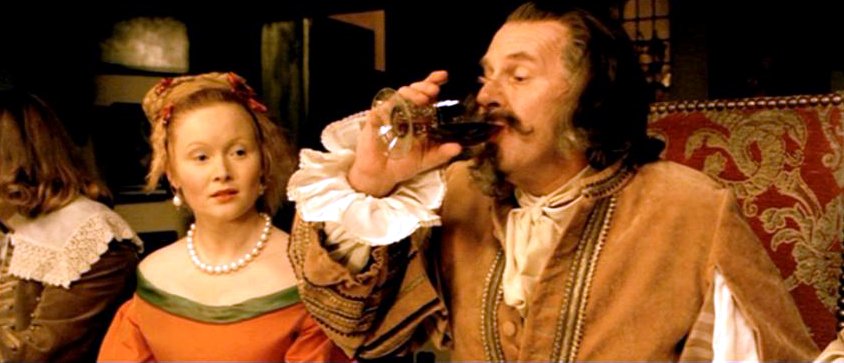
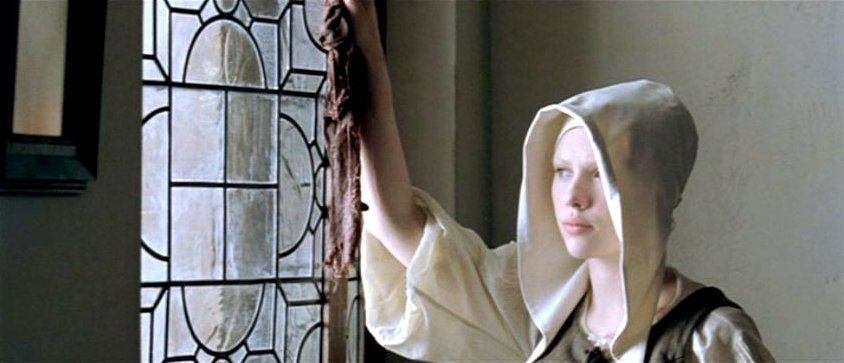
Top: Vermeer's wife Catharina (Essie Davis) and the local art collector Pieter van Ruijven (Tom Wilkinson).Bottom: Griet (Scarlett Johansson) cleaning the windows of Vermeer's studio, just before their eyes meet.
When the film was released in The Netherlands in April 2004, I hurried to see it. Having enjoyed the book so much, I was ready to be disappointed by the film, and to be honest, I was just a little bit. However, having just watched it again on DVD, and again listening to the director's comments, I have revised my opinion and have concluded that I am not disappointed at all, so much so, that I feel inspired to write about it and to draw some comparisons between book and film.
My first disappointment in the film came right at the beginning, when I felt that Vermeer and his wife should, as in the book, have been seen to visit Griet's home when considering taking her into service, as it was on that occasion that they had witnessed her creation of the chopped-vegetable pie-chart. Vermeer had recognised her eye for artistic detail, which he had seen in nobody else, especially not in his wife, who had little appreciation of art and was rather clumsy, as typified by her knocking the vegetable-knife off the table and sending it spinning across the floor. He had known instantly that he could trust Griet with the cleaning of his precious studio! In the film, we get a glimpse of the vegetable arrangement and the spinning knife, but don't get to see the Master till much, much later when Griet has already been working in his house for several days. Their first real encounter is in the studio and is a very significant moment in the film, coming after a big build-up. The head maid, Tanneke, has already explained why his wife, Catharina, has not been allowed in the studio for so long; they had ushered her into the studio, themselves remaining on the threshold, furtively peering through the doorway – she had opened the shutters, at Catharina's command, so throwing light onto the darkened studio and we saw the way her eyes lit up when she first saw the half-finished painting on the easel. Before entering himself and seeing Griet reaching up to clean the windows, Vermeer lurks in the doorway silently watching her, and immediately we can sense the unspoken, forbidden chemistry between them – the perfect build up! The fact that the man in question is Colin Firth makes this moment worth waiting for!
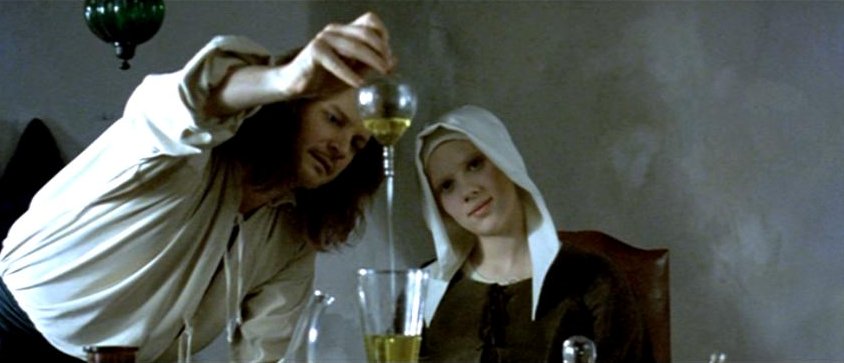
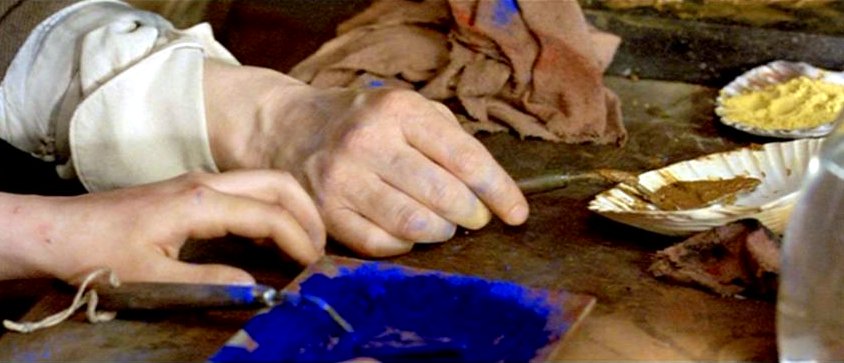
Vermeer (Colin Firth) and Griet (Scarlett Johansson) preparing paints together.
The book gives us many more facts than the film; for example, about Griet's father's accident when the tile-firing kiln exploded leaving him blind and injured, such that he could no longer practise his trade and hence necessitating that Griet go into service to save the family from starving. The film also tells us nothing of her brother who suffered terribly during his arduous apprenticeship, nor of her sister who was devastated at Griet's departure and at her subsequent distancing from her family. In the film, one glimpse of her father's cruelly disfigured face and hand tells us enough – no explanation is needed! Again later, a great line in the book: “I never thought I would learn from a maid”, spoken by Vermeer after altering his painting at Griet's silent bidding, is rendered superfluous in the film by the look that passes between them and the closeness of their hands as they mix colours – it says it all!
I now realise that in film, emotions are immediately visible and often make facts unnecessary. As emotions and relationships develop, the story unfolds and races onwards. Additional facts about Griet's family background would have hindered the unfolding, and her mother's tortured expression as she has to part with her daughter communicates all we need to know about the family's circumstances.
The intricate descriptions in the book give us a vivid mental impression of the thoughts and feelings of the characters and of the life of the household, whilst leaving our imagination to create our own actual images. This is part of the charm of books. However, when we watch a film, especially a period drama as well done as this one, we are immersed in the situation and actually experience the things as they happen:
the sounds, of footsteps above her when she is feeling isolated in the cellar, and of babies crying below her when she is isolated in the studio, of the laundry water bubbling, of the geese and chickens and of the pet parrot, and of the all-important chair as she drags it across the floor, so putting into action her suggested change in the painting scene, which in the book, incidentally, is a subtle and silent change in the folds of the blue table cloth – very different;
the hustle and bustle and the smell of the meat market;
the coldness, visible in the freezing breath and the frozen-stiff nightshirt;
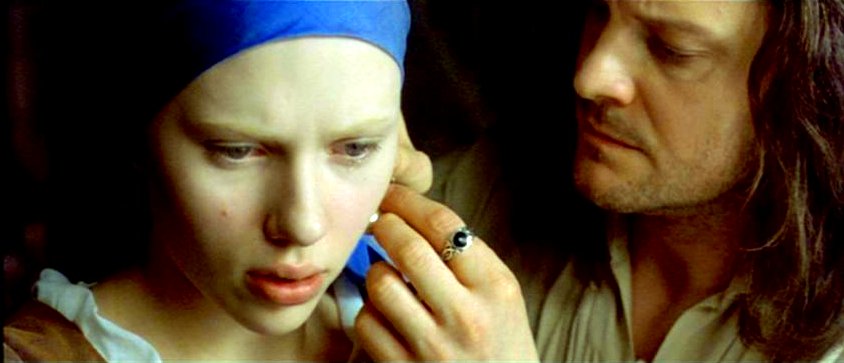
the facial expressions and eye contact – the tear as he inserts the earring and the shared emotion as he wipes away her tear with his thumb. Here, another difference between book and film: in the film he tenderly pierces her ear himself at her request – in the book she has had advance warning and has pierced her ear herself with the help of numbing clove oil (less painful but less romantic) and the tenderness is further impaired by his insistance on her painfully inserting the other earring, which couldn’t be seen – his obsession for his work making him selfish. In fact, the use of the earrings at all: quinttessential for the painting, fateful for Griet, bears witness to his selfishness. Of course, the film gives a hint of this aspect, but by being less expicit the romantic feeling is less impaired.
the flashes of realisation seen in the eyes, of Tanneke, when she realises the implications of the change of sleeping places, of Vermeer when Griet describes the clouds and he realises that she sees beauty, light and colour as he does, while others see only commonplace things, and of Griet, when she realises and is shocked at her master's unwitting insult to his wife when he quietly points out to her the artistic value of the pearl in his wife's ear;
the light versus shadow (of course, a key element in Vermeer's work), the camera obscura, a brand new invention of the time, and the reflection she observes in the silver bowl she is cleaning;
the hesitation and wordlessness, especially as she leaves the house for the last time knowing that he is standing silently behind the door
– all of these things work together to give us such a ‘real’ picture, that we can do without lots of facts. Maybe we do need to be rather thoughtful, patient viewers to appreciate all of these things, but perhaps that also applies to appreciating Vermeer's paintings!
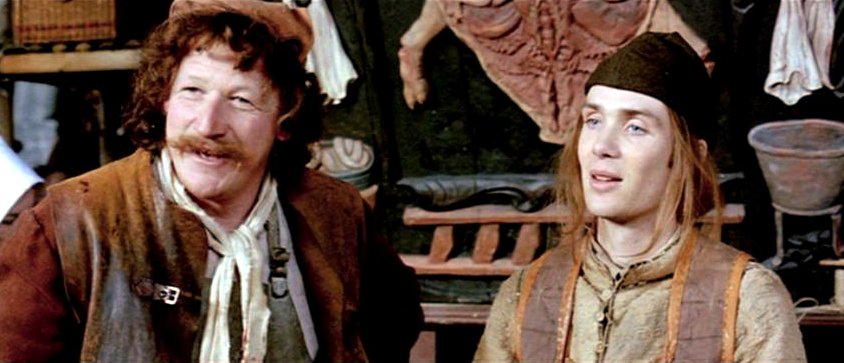
Top: Paul the butcher (Geoff Bell) and his son Pieter (Cillian Murphy) selling meat at a local market.Bottom: Vermeer (Colin Firth) putting the pearl earring on Griet (Scarlett Johansson), shortly after piercing her ear.
The scenery of the film is second to none! Despite many of the scenes having been filmed in Luxembourg, Belgium, and Venice in order to show life lived at the water's edge, using the canals for transportation, but also for so many other daily functions (Holland is too spick and span and would have required more set-building), it portrays perfectly how I imagine how the Dutch lifestyle would have been at the time. The glimpse of Vermeer's famous painting, “View of Delft”, displayed behind Griet when she is (reluctantly) in the house of Vermeer's lecherous, all-powerful patron, van Ruijven, together with the real-life views of Delft's market square, the old town hall with its unmistakable red shutters, and the Nieuwe Kerk, all serve to place the location firmly in the Netherlands.
Here again, the book explains more about the significance of the star in the centre of the market square, which incidentally disappeared just a few months after the shooting of the film, when the square was repaved in preparation for the funeral of Prins Bernard in December 2004 (such a shame after so many years, but at least the film made it in time!). The star was important for Griet as she and her brother and sister had played and explored by following each point of the star. It features again at the end, as she stands in the centre wondering which direction to go to find her future.
The book fast-forwards ten years to Vermeer's death, and we see Griet happily married to Pieter, the butcher's son, with two children, her mother finally able to eat meat, and her father having passed away. We learn that Catharina is forced by the lawyer handling the will to hand over the earrings to Griet, and how painful it is for her to comply. Griet also hears from one of the sons that his father had borrowed back the painting of her and had it by him as he died – all very emotional! The film is open-ended: soon after Griet's departure, Tanneke comes, presumably to her house, and gives her a cloth containing the earrings. Griet just scrunches it up in her hands and the film ends by focusing on the painting itself, which cannot but be appropriate. However it leaves us with unanswered questions. Having read the book first, I can't judge whether film-viewers who have not read it predict the ending, but I'm sure they know she will turn to Pieter – after all, she already made a commitment after realising that her master actually did still love his wife, and why not – Pieter is rather nice – much nicer than I had pictured him when reading!
This brings me to the two essential features of film – how can I have left them until last?!: the music and the actors. Alexandre Desplat's haunting music beautifully fills any otherwise silent moments, and the acting is superb. It goes without saying that Colin Firth is brilliant, his subtle smile captivating, but all of the actors are great! Especially the women: Essie Davis' haughty but sad Catharina; Judy Parfitt's austere but understanding mother-in-law, Maria Thins; Joanna Scanlan, the perfect, plump head maid, Tanneke; Alakina Mann as the smirky, callous daughter, Cornelia; and of course, Scarlett Johansson as the innocent yet sensuous Griet, who just happens to look so much like the girl in the painting! I think Vermeer would have approved of these women – most of his paintings are of house interiors including a woman.
In conclusion, the “Girl with a Pearl Earring” painting is a masterpiece, and both the subsequent book and the period-drama film are great! We don't have to choose between them; they complement each other and each excels in its own way. I'm sure that the author and film director have mutual respect for one another, and it would be nice to imagine that Johannes Vermeer himself would also have had respect for both of these art forms, which highlight his genius and have brought his work to the attention of so many! http://www.perioddramas.com/articles/girl-with-a-pearl-earring.php
Saturday, 18 January 2014
The 2004 BBC mini-series ‘North and South’ provides us with yet another brilliantly turned-out, authentically and atmospherically-set period drama that throws us back in time and brings history alive for us, albeit through a fictional story. As with most period dramas, this story has, at its core, the gradual development, from most unlikely beginnings, of a romance between a beautiful woman and a handsome man coming from different classes. In this respect, it can be compared with Pride and Prejudice; also in the fact that in both cases the initial proposal of marriage is most disdainfully refused as preposterous by the lady in question. The romance between Elizabeth Bennet and Mr Darcy has a rocky enough beginning and a stony enough rejection, but even this impossible-case scenario is eclipsed by the apparent impossibility of a match between Margaret Hale and Mr Thornton.
In North and South, the lady is Margaret Hale and it is the changes in her outlook and character that are the main focus of the story; in fact Elizabeth Gaskell, the author of the book on which the film is based, originally intended to entitle it ‘Margaret’ or ‘Margaret Hale’. She was persuaded to change the title to ‘North and South’ by Charles Dickens who agreed to publish her story in 1854 in serialized form in his weekly journal ‘Household Words’; she proceeded to re-emphasize the ‘Margaret’ aspect for the publication in book form a little later. The title ‘North and South’ embodies the stark contrast between two geographically opposite points and between two diametrically opposed lifestyles. Dickens chose it to highlight the conflict between the north and south of England at a time when public unrest was escalating on account of the ‘outrageous’ new developments caused by the Industrial Revolution, which took place in the north from the late 1700s through to the mid 1800s. Until this time, wealth had mainly come from agriculture so the landowning aristocracy were in control, and could lead a life of comfort as there were plenty of poor labourers to work the land for them. In return for their labours from generation to generation, the workers could expect to be provided with simple houses, basic food and, when times were bad, the occasional charitable gift from their masters, or more often from the lady of the house. In other words, the privileged realized that their position carried with it some degree of responsibility for those who worked for them. The Industrial Revolution changed all this. The new bosses were the men who controlled the natural resources, such as coal and water to run the machinery, and the factory owners and tenant managers. The owners and managers of mines and cotton mills (the textile industry was one of the first to be mechanized) were not such benevolent masters; they paid meagre wages but expected their workers to fend for themselves; their employees' private lives were none of their business. Factory bosses themselves had often worked their way up from poverty so they well understood hardship, but had had to be hard to reach that position; Mr Thornton in our story is one such case. Dickens was very aware of the turbulent changes taking place in the society of his day, and the plight of the poor. This situation was the backdrop to most of his stories, especially ‘Hard Times’, which was also first published in 1854 in instalment-form for his journal, ‘Household Words’, most articles in which dealt with these issues. The serialized ‘North and South’ fitted the genre perfectly.
There was mutual disdain between northerners and southerners at the time, around 1850. The ‘upper-class’ people from the south considered their lifestyle to be refined and civilized, while that of the north was crude, dirty and based only on earning money. People of the north considered the southern lifestyle to be boring and the people to be spoilt and complacent, while they in the north got on with the hard work of life. Actually, these views haven't completely died out to this day, and the current discrepancy in job opportunities and wages reflect this! In our story, these prejudices ensconced in our two main characters are gradually broken down.Margaret Hale grew up in comfortable, aristocratic and professional circles, despite her father's ‘living’ as a clergyman not stretching to as many smart new gowns for his wife as she would have liked. Margaret spent ten years living with her Aunt Shaw and cousin Edith who lived as gentry in London, only staying at the parsonage with her less affluent parents in the beautiful southern village of Helstone for holidays. After Edith's no-expense-spared wedding to a Captain Lennox, and Margaret's own refusal of his lawyer brother's proposal of marriage to her, Margaret looks forward to returning to life at the parsonage only to hear from her father that the family is about to relocate to the industrial north. Mrs Hale is only informed of this at the very last moment; she is shocked to the core, and can never really accept that her husband's long-deliberated conviction that his doubts concerning his faith forced him to quit his job was sufficient reason to ‘condemn’ the family to such a fate.
Anyway, when the family arrive in the northern industrial town of Milton, Margaret and her mother's worst fears are confirmed. Margaret's introduction to Mr Thornton couldn't have been worse, as she witnessed his harsh and violent treatment of one of his employees who he had caught smoking. Later he has the chance to explain to her, but only much later does she begin to understand the fact that the punishment he had administered was done in the interest of the employees, for whom he was responsible; a recent fire at his mill had caused the death of 300 workers, including many children, and he had found the experience of burying them heartbreaking. Thornton's disciplinary action is defended as justified by a very freethinking and pro-active mill worker Nicholas Higgins, who is at the time busy trying to rally his fellow workers to take strike action to improve their lot. It is interesting that these two men at the opposite ends of the spectrum, one a company boss, the other the leader of the rebels, in fact have a lot in common. They both strongly believe in their principles and stand by them: Higgins at one point mentioning that he would sooner die at his post than yield; Thornton being prepared to bring in Irish labourers to break the strike at whatever risk to himself, while fellow bosses were willing to give in. He genuinely seems to believe (true or not, I don't know) that he can't afford to pay his workers more without going under, so that it is actually in the workers' interest for the strike to fail: “It's our livelihood at stake, but it's their lives!”
Actually, Margaret's brother Frederick's action in standing up for his principles and the rights of his fellow seamen falls into a similar category. Interestingly, The Combination Acts of 1799, which were passed to prevent mutinies during the Napoleonic Wars (poor Frederick was blacklisted as a mutineer, hence having to flee the country for fear of being court-martialled and surely facing the death penalty) were used for decades to suppress Trade Unions. Since then of course, various Government Acts have been passed dealing with the issue of compensation for strikers. Situations differ from country to country; in England, for example, the rights of strikers are still very different from those in France, where the right to strike is recognized and guaranteed by the Constitution – things are not so clear-cut in other countries. Of course, the governments of different countries have also since accepted responsibility for social welfare to varying degrees; ‘North and South’ shows us most clearly the dire consequences of there being no system of benefits in place, as was the case at that time.
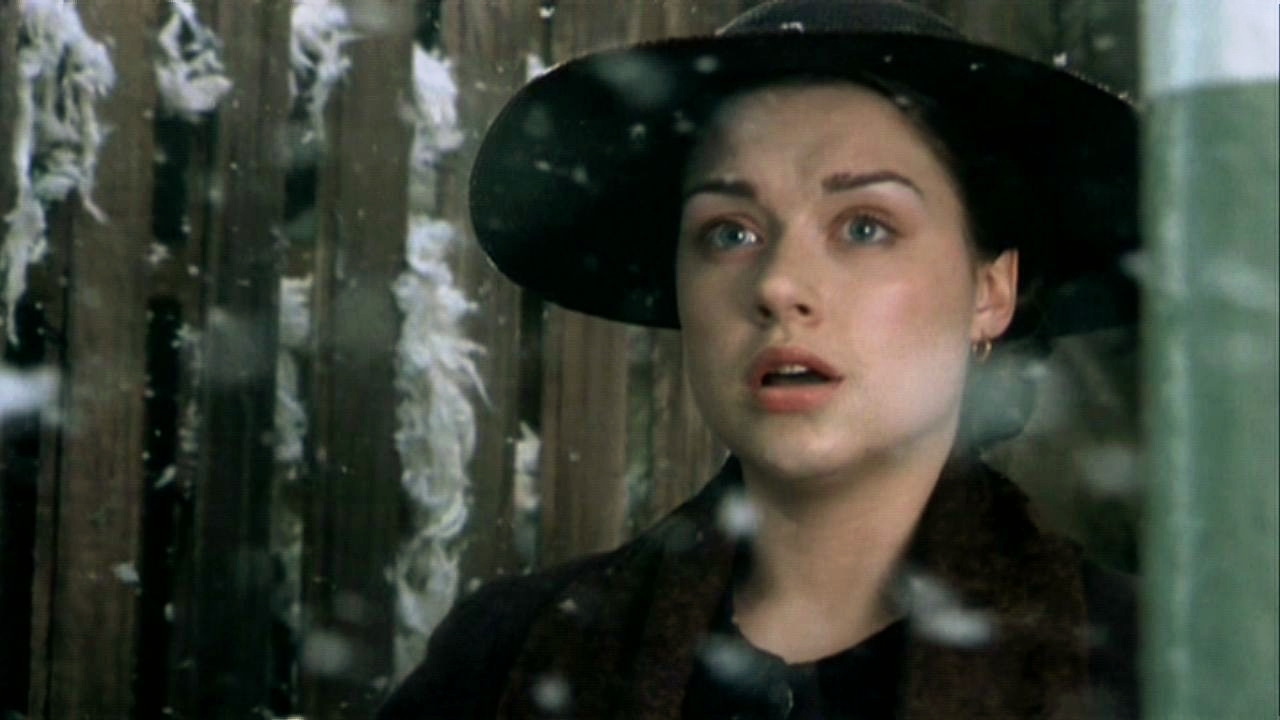
Margaret Hale (Daniela Denby-Ashe) as she first sees the cotton snowflakes at Thornton's cotton factory. BBC 2004. Screencap credit: Desert Sky Screencaps.
The mill workers certainly had a case for striking: the conditions in the factory were appalling! We, and Margaret, are at first entranced by the seemingly beautiful sight of huge ‘snowflakes’ floating through the air inside the work-hall of Marlborough Mills, of which Mr Thornton is the boss. These ‘snowflakes’ turn out to be deadly fluffy cotton fibres that are slowly but surely blocking up the lungs of the workers. Again showing concern for his workers as well as for his business, Mr Thornton has taken action, in advance of his peers, to reduce this air pollution by installing a special, newly invented ventilation wheel. However, the improvement is nowhere near enough and the damage is already done; ringleader Nicholas Higgins' daughter Bessie, who has become best friends with Margaret, succumbs to the killer lung disease along with many others. Margaret is shocked to experience the human suffering she sees all around her, especially that of the families of striking workers who can't afford to feed their children, and her ‘southern’ compassion prompts her to take baskets of food to help out, for which she is criticized for helping to prolong the strike rather than helping. Finally, as the deadlock continues, poor John Boucher tragically takes his life, followed shortly by his wife, leaving six starving orphans.
Margaret's spontaneous expression of compassion also leads her to step in front of Mr Thornton to protect him from ‘missiles’ hurled at him by the strikers incensed by his bringing in Irish workers to break the strike. She does this without thinking, as the incident occurs long before she realizes that her feelings towards him are beginning to change. The fact that Margaret's actions are misinterpreted by John's mother (who later talks him into proposing to Margaret, as protocol demanded) serves to highlight the gulf between the old traditional view of womanhood and Margaret's ‘modern’ view of it. Persuading her son in this way must really have gone against the grain for the poor mother, as she is not at all fond of Margaret and considers her to be in no way worthy of her son. Anyway, at the time, Margaret refuses him in no uncertain terms!
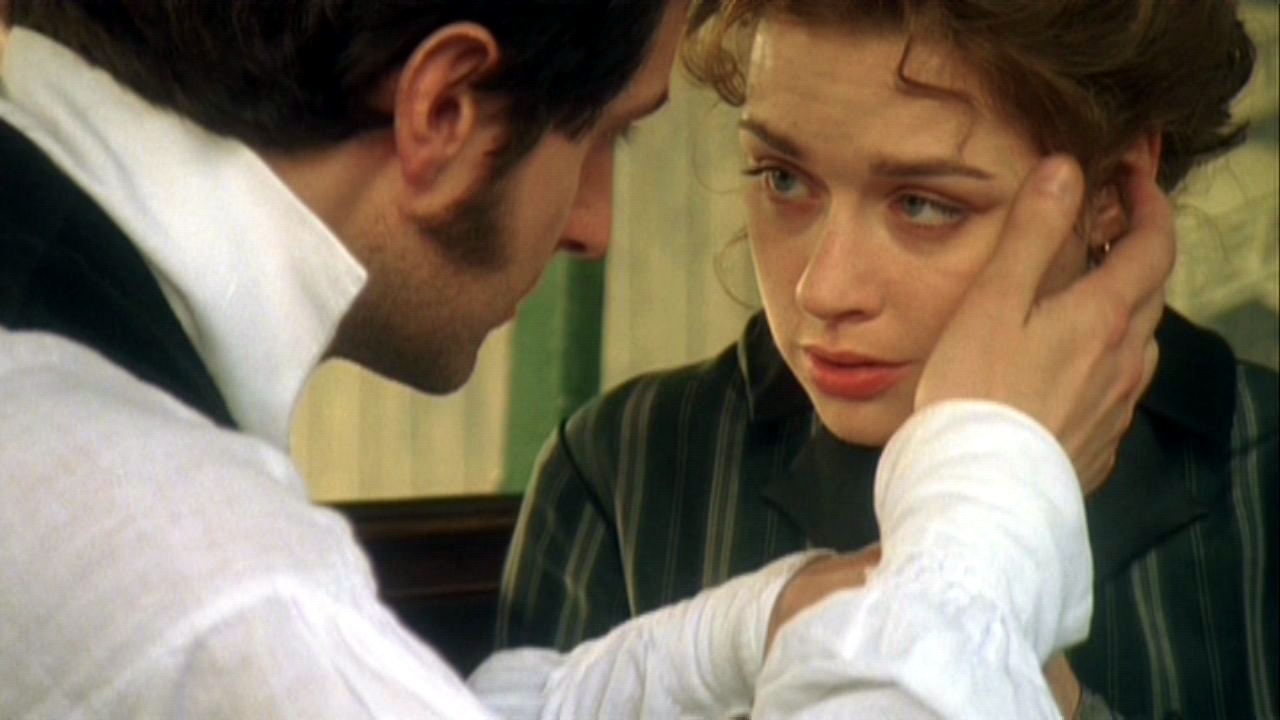
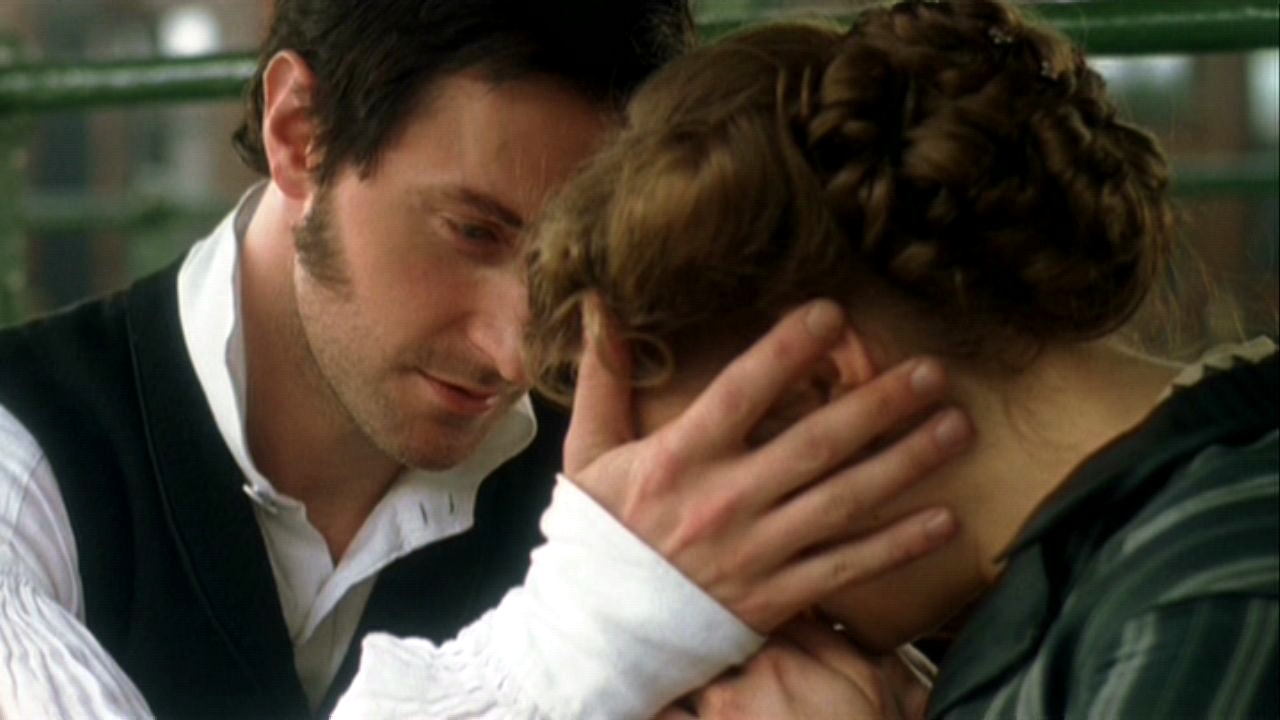
Margaret Hale (Daniela Denby-Ashe) and John Thornton (Richard Armitage) at the railway station, finally realising each other's true feelings. BBC 2004. Screencap credit: Desert Sky Screencaps.
However, in due course, the most unlikely becomes reality! Mr Thornton and Mr Higgins finally realize that they do indeed have many principles in common and discover mutual respect for each other. Together they set up a works canteen where both the boss and the workers can eat cheaply, to everyone's advantage – it is Higgins' sense of duty and determination to feed the Boucher orphans (and Thornton's admiration of him for doing so) that precipitates this, and it is Higgins' remaining daughter Mary who is the cook. Thornton's hard-hearted mum finally ‘softens’ just a little bit; but most importantly, John Thornton and Margaret finally resolve their differences, acknowledge their feelings for each other and realize they can't live without each other. Their north versus south prejudices have proven unfounded - Margaret is shocked to discover that she has practically swapped her allegiance; perhaps she has also begun to see the attraction of the ‘northern’ harder form of masculinity, and John in turn has come to realize that strength needn't exclude compassion.
So, we finally witness the touching love scene that takes place on the platform of a railway station somewhere between Milton and London, where they meet when their trains cross, after both of them have set out to retrieve each other; he produces a yellow rose picked in her beloved Helstone; she timidly spells out a proposition. At first, she is too shy to disclose her feelings for him openly; she might disparagingly have been described as ‘strong-minded’ for a woman, but she isn't that emancipated! Instead she attempts to disguise her feelings by offering him a purely business deal. She has just inherited a large sum of money, and property, from a Mr Bell, an old friend and ex-Oxford-tutor of her father's, and a godfather to Frederick. He had actually been instrumental in Mr Hale's decision to relocate to Milton in the first place. He knew that Mr Hale wanted to escape from Helstone to a place where nobody knew of his leaving the church, and he found him a potential classics' student in the tenant manager of Marlborough Mills (of which he was the owner), namely John Thornton. Mr Bell had become very fond of Margaret and wished to take care of her after the death of her mother and father. He had rather hoped that she might even marry him to look after him in his old age (and final months, as it turns out), but when she dashes his hopes, he benevolently hands over to her the bulk of his assets, including Marlborough Mills. She is now a rich woman and she offers John money to enable him to continue running the mill, which had had to close down on account of his over-cautious decision concerning an investment. She tries to sell him the idea by explaining that the money is just lying in the bank; she, as a woman, would not be allowed to do much with it, whereas he could put it to very good use, giving work again to those who depended on him; in the process, she says, paying her higher interest than the bank. Luckily, John is well able to see her true feelings for him through this guise, and we have the happy ending to our love story.
We are lucky enough to have so many great period dramas, but ‘North and South’ always seems to rate as one of the best; it comes top of the rating in the Top Ten list, as voted by visitors to this website. Maybe this is partly due to the fact that it not only is a great love story, but also involves so many important issues that are still relevant today, such as employment rights and prejudices that shouldn't exist and should be broken down. However, the main reason for its high rating is probably the fact that it is a very good period drama! All the characters are well formed and convincing, and I imagine that Elizabeth Gaskell would be very happy with the actors' portrayal of them. Richard Armitage, as John Thornton, with sharp facial features suggesting resolute determination but with deep-set expressive eyes which later betray a softness inside; Daniela Denby-Ashe, as the spontaneous and compassionate Margaret, whose thoughtful face can light up in a second with a wide cheery smile; Tim Pigott-Smith as her gentle, academic father;Sinéad Cusack as her mum, sweet but peeved: Anna Maxwell Martin (well known to me from ‘Bleak House’ and ‘Becoming Jane’) as Bessie, cheerful and pragmatic, even on her deathbed; Brendan Coyle (from ‘Larkrise to Candleford’ and ‘Downton Abbey’) deep-thinking and determined, ‘standing on principle’ but with a strong moral sense of honesty and duty; and Pauline Quirke (from ‘David Copperfield’ and ‘Little Dorrit’) as Dixon the maid who considers herself to be the mistress's ‘protecting fairy’ – perfect for the part, as were all the actors for their parts!
What is so special about period drama? What distinguishes this genre of film from the others is that whereas the majority of films are fictional, period dramas are based, however loosely and with however much poetic licence, on historical facts. Consequently, while all films offer escapism from our worries and stress, a period drama transports us back in time and engulfs us in a lifestyle of a bygone era, so giving us a glimpse of the world as experienced by our ancestors – that can't help but be captivating!
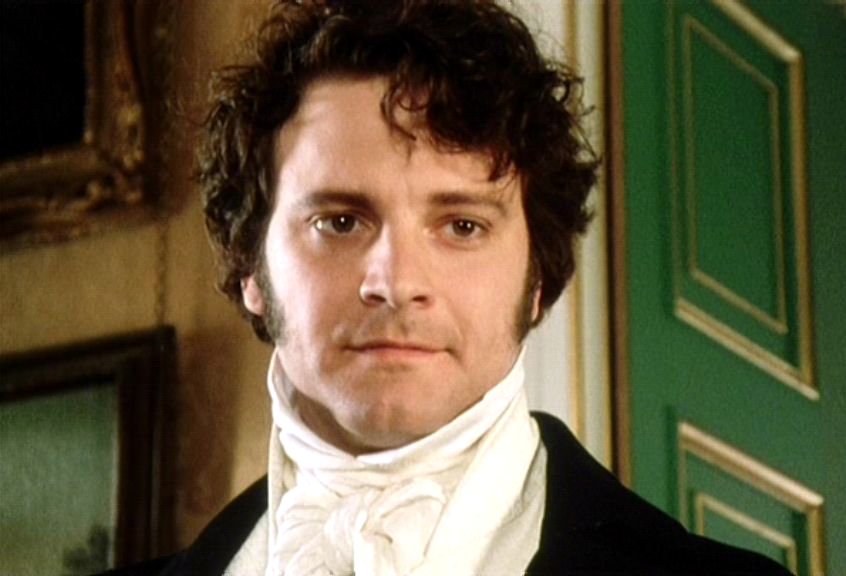
That period dramas are sometimes known as costume dramas is not surprising as their most immediate and conspicuous feature is the costumes. None of us would gladly swap our jeans for such uncomfortable attire, but we find the costumes fascinating and charming to see – Colin Firth's impact on female viewers in his role as Mr. Darcy in the 1995 BBC TV mini-series “Pride and Prejudice” was at least in part due to how stunning he looked in his costume! Despite his having played so many other roles in popular films, including “Mamma Mia”, his rendition of Mr. Darcy is the lasting impression we have of him, together possibly with his Johannes Vermeer in “Girl with a Pearl Earring”.
Alongside the costumes come the deftly transfigured town and country settings, which serve to complete the illusion that we are in a different age. Some may be purpose-built sets, but others must be real city scenes that have been miraculously altered and filmed with all traces of the present day eliminated. Interior décor of houses, castles, ships, old cars, trains and railway stations, depending on the period, all offer powerful imagery to enhance the illusion.
Period dramas come in all types, ranging from the peaceful, romantic sagas focusing on family life, such as the Jane Austen dramas, to the violent, action stories of Shakespeare's kings. Some have feel-good, happy endings, typically where everyone happily marries their chosen one; others profoundly sad endings, such as “Tess of the D'Urbervilles”, where we are left in tears. Many show us the enormous gulf that existed between rich and poor (even more than today), where the rich were all powerful and the poor were bereft of any semblance of justice, or, at best, subject to unforgivably hard justice, as typified by “Les Miserables”. Such films serve to remind us how thankful we should be for medical advances and our health and legal systems, even if we do complain about them!
There really is a genre of period drama to suit us all. I imagine there may be a distinct gender divide. As a female, I enjoy those peaceful dramas where the pace of life is gentle and the accent is on people's thoughts and feelings rather than on action. We see that some women were frustrated by the restrictions placed on them by society, as we certainly would be too, but we also observe that women in Jane Austen's day seemed to have quite a nice peaceful existence, which appears rather attractive when we are feeling too busy! In her world, even in families that considered themselves quite poor (not the really poor!), the work load of the lady of the house comprised controlling the housekeeping, not actually doing the housework herself! For her daughters, “work” was nothing more arduous than sewing: mending, altering (to comply with the latest fashion) and making nightwear/underwear during the privacy of the mornings; more delicate work, such as embroidery, in the afternoons when a visitor might call. And for the whole family, the evenings were devoted to sociable pursuits (actually, I happen to really enjoy sewing, but don't often seem to find the time!). This type of film doesn't appeal to my husband – not enough action! I guess the male of the species, being the hunter, is inherently more active. His macho hormones dictate that his preferred genre of film must contain elements of adventure, violence and intrigue. There are plenty of period dramas that provide all of these. Fighting has always been a way of settling disputes, both on and off the battlefield: having sex has, of course, always been a fundamental part of life, and in the past there were fewer other forms of entertainment; and monarchs of yesteryear had the power to dispose of unwanted rivals and seemed to have no scruples about using that power. Consequently, fierce fighting, passionate love-making and royal executions feature accordingly in the more violent types of period drama.
Whatever type of period drama is for each of us, all of them provide a great form of escapism. What they all have in common is that life was less complicated then than it is now, with all our many options but so many accompanying stresses! This for me is the key to period drama's appeal. To escape, we can also look to the future. This may be very exciting but I can only imagine that life in the future will have even more complications and stress. Personally, for entertainment, I prefer to look back towards simplicity. It’s more relaxing!
 Downton Abbey is a British period drama television series created by Julian Fellowes and co-produced by Carnival Films and Masterpiece.[1] It first aired on ITV in the United Kingdom and Ireland on 26 September 2010 and on PBS in the United States on 9 January 2011 as part of the Masterpiece Classic anthology. Four series have been made so far; a fifth is planned for 2014.