“Girl with a Pearl Earring”: essentially the beautiful painting by the Dutch artist Johannes Vermeer (1632–1675), but also a captivating book by Tracey Chevalier and Peter Webber's haunting film released in 2003.
Living in the Netherlands close to Delft, where Vermeer lived probably all his life (although many details of his life, including his precise date and place of birth remain unknown), I have a natural interest in him and admiration for his work. When in 1996 an exhibition of 22 of Vermeer's 35 known paintings came to the Mauritshuis Museum in The Hague, the country was abuzz with the name “Vermeer”, and such was the demand that it was all but impossible to get an appointment to see it! When Tracey Chevalier's book was published and available in the bookshops, copies flew off the shelves like hotcakes. I loved the book and read it several times. Of course, it is a fictional interpretation of Vermeer's life in which the author is entitled to exercise any amount of poetic licence. However, judging from the small number of works accomplished in his lifetime and the fact that he had a wife, mother-in-law and eleven children, plus the servants, to feed, I can well imagine that the women in his life would have preferred him to have churned out more pictures and might have been a bit frustrated at his obsessive reverence to his art, which they didn't understand and which slowed him down. For this reason I have the feeling that we could be seeing quite a true likeness both in the character of the real and fictional man, and in the lifestyle of a Dutch artist of the time.

 Top:
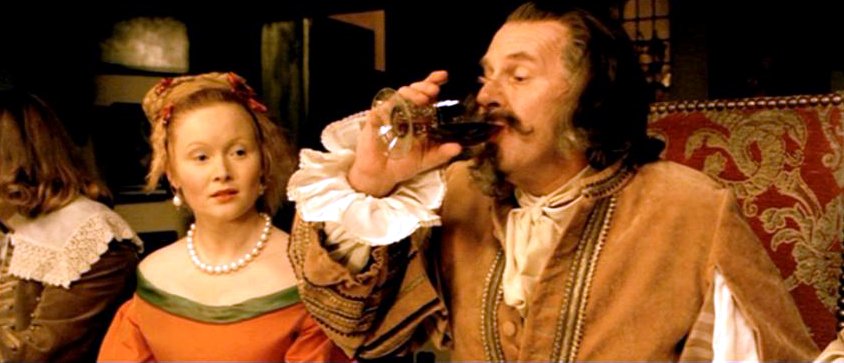
Top: Vermeer's wife Catharina (Essie Davis) and the local art collector Pieter van Ruijven (Tom Wilkinson).
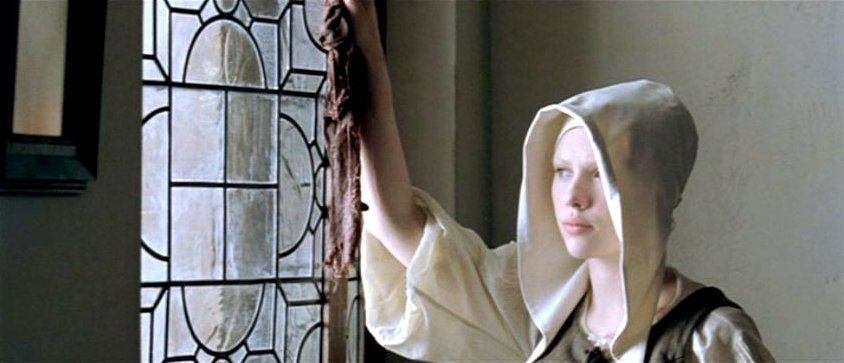
Bottom: Griet (Scarlett Johansson) cleaning the windows of Vermeer's studio, just before their eyes meet.
When the film was released in The Netherlands in April 2004, I hurried to see it. Having enjoyed the book so much, I was ready to be disappointed by the film, and to be honest, I was just a little bit. However, having just watched it again on DVD, and again listening to the director's comments, I have revised my opinion and have concluded that I am not disappointed at all, so much so, that I feel inspired to write about it and to draw some comparisons between book and film.
My first disappointment in the film came right at the beginning, when I felt that Vermeer and his wife should, as in the book, have been seen to visit Griet's home when considering taking her into service, as it was on that occasion that they had witnessed her creation of the chopped-vegetable pie-chart. Vermeer had recognised her eye for artistic detail, which he had seen in nobody else, especially not in his wife, who had little appreciation of art and was rather clumsy, as typified by her knocking the vegetable-knife off the table and sending it spinning across the floor. He had known instantly that he could trust Griet with the cleaning of his precious studio! In the film, we get a glimpse of the vegetable arrangement and the spinning knife, but don't get to see the Master till much, much later when Griet has already been working in his house for several days. Their first real encounter is in the studio and is a very significant moment in the film, coming after a big build-up. The head maid, Tanneke, has already explained why his wife, Catharina, has not been allowed in the studio for so long; they had ushered her into the studio, themselves remaining on the threshold, furtively peering through the doorway – she had opened the shutters, at Catharina's command, so throwing light onto the darkened studio and we saw the way her eyes lit up when she first saw the half-finished painting on the easel. Before entering himself and seeing Griet reaching up to clean the windows, Vermeer lurks in the doorway silently watching her, and immediately we can sense the unspoken, forbidden chemistry between them – the perfect build up! The fact that the man in question is Colin Firth makes this moment worth waiting for!


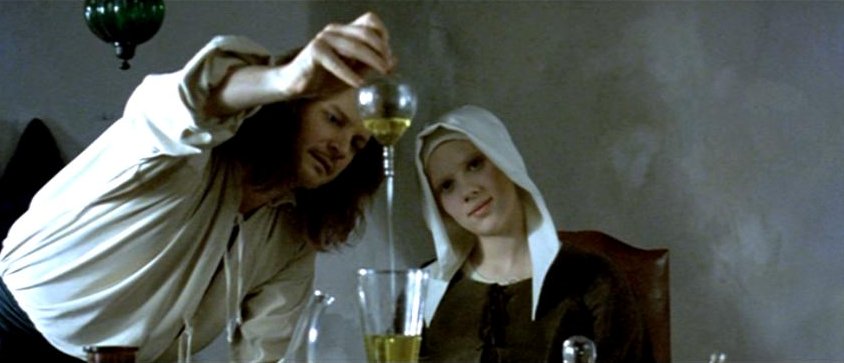
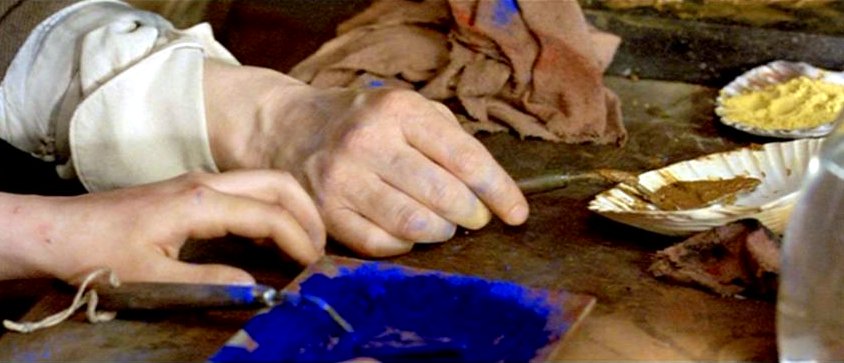
Vermeer (Colin Firth) and Griet (Scarlett Johansson) preparing paints together.
The book gives us many more facts than the film; for example, about Griet's father's accident when the tile-firing kiln exploded leaving him blind and injured, such that he could no longer practise his trade and hence necessitating that Griet go into service to save the family from starving. The film also tells us nothing of her brother who suffered terribly during his arduous apprenticeship, nor of her sister who was devastated at Griet's departure and at her subsequent distancing from her family. In the film, one glimpse of her father's cruelly disfigured face and hand tells us enough – no explanation is needed! Again later, a great line in the book: “I never thought I would learn from a maid”, spoken by Vermeer after altering his painting at Griet's silent bidding, is rendered superfluous in the film by the look that passes between them and the closeness of their hands as they mix colours – it says it all!
I now realise that in film, emotions are immediately visible and often make facts unnecessary. As emotions and relationships develop, the story unfolds and races onwards. Additional facts about Griet's family background would have hindered the unfolding, and her mother's tortured expression as she has to part with her daughter communicates all we need to know about the family's circumstances.
The intricate descriptions in the book give us a vivid mental impression of the thoughts and feelings of the characters and of the life of the household, whilst leaving our imagination to create our own actual images. This is part of the charm of books. However, when we watch a film, especially a period drama as well done as this one, we are immersed in the situation and actually experience the things as they happen:
- the sounds, of footsteps above her when she is feeling isolated in the cellar, and of babies crying below her when she is isolated in the studio, of the laundry water bubbling, of the geese and chickens and of the pet parrot, and of the all-important chair as she drags it across the floor, so putting into action her suggested change in the painting scene, which in the book, incidentally, is a subtle and silent change in the folds of the blue table cloth – very different;
- the hustle and bustle and the smell of the meat market;
- the coldness, visible in the freezing breath and the frozen-stiff nightshirt;
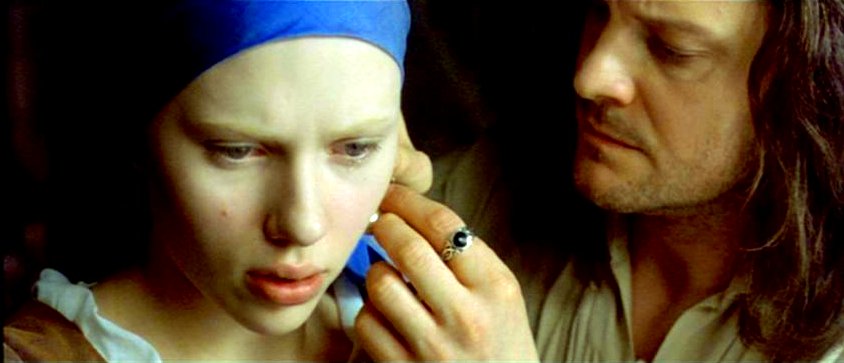
- the facial expressions and eye contact – the tear as he inserts the earring and the shared emotion as he wipes away her tear with his thumb. Here, another difference between book and film: in the film he tenderly pierces her ear himself at her request – in the book she has had advance warning and has pierced her ear herself with the help of numbing clove oil (less painful but less romantic) and the tenderness is further impaired by his insistance on her painfully inserting the other earring, which couldn’t be seen – his obsession for his work making him selfish. In fact, the use of the earrings at all: quinttessential for the painting, fateful for Griet, bears witness to his selfishness. Of course, the film gives a hint of this aspect, but by being less expicit the romantic feeling is less impaired.
- the flashes of realisation seen in the eyes, of Tanneke, when she realises the implications of the change of sleeping places, of Vermeer when Griet describes the clouds and he realises that she sees beauty, light and colour as he does, while others see only commonplace things, and of Griet, when she realises and is shocked at her master's unwitting insult to his wife when he quietly points out to her the artistic value of the pearl in his wife's ear;
- the light versus shadow (of course, a key element in Vermeer's work), the camera obscura, a brand new invention of the time, and the reflection she observes in the silver bowl she is cleaning;
- the hesitation and wordlessness, especially as she leaves the house for the last time knowing that he is standing silently behind the door
– all of these things work together to give us such a ‘real’ picture, that we can do without lots of facts. Maybe we do need to be rather thoughtful, patient viewers to appreciate all of these things, but perhaps that also applies to appreciating Vermeer's paintings!

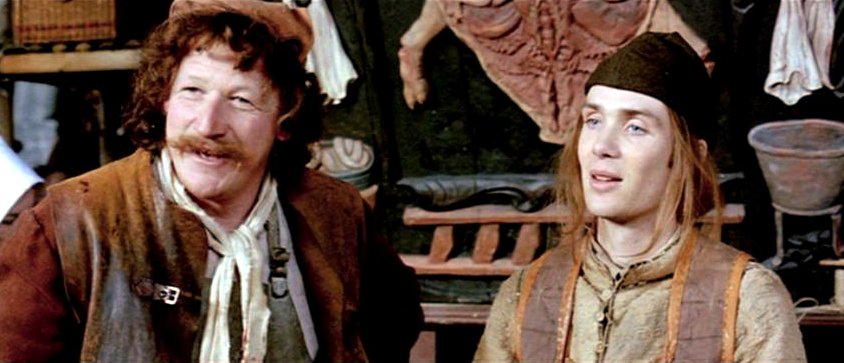
 Top:
Top: Paul the butcher (Geoff Bell) and his son Pieter (Cillian Murphy) selling meat at a local market.
Bottom: Vermeer (Colin Firth) putting the pearl earring on Griet (Scarlett Johansson), shortly after piercing her ear.
The scenery of the film is second to none! Despite many of the scenes having been filmed in Luxembourg, Belgium, and Venice in order to show life lived at the water's edge, using the canals for transportation, but also for so many other daily functions (Holland is too spick and span and would have required more set-building), it portrays perfectly how I imagine how the Dutch lifestyle would have been at the time. The glimpse of Vermeer's famous painting, “View of Delft”, displayed behind Griet when she is (reluctantly) in the house of Vermeer's lecherous, all-powerful patron, van Ruijven, together with the real-life views of Delft's market square, the old town hall with its unmistakable red shutters, and the Nieuwe Kerk, all serve to place the location firmly in the Netherlands.
Here again, the book explains more about the significance of the star in the centre of the market square, which incidentally disappeared just a few months after the shooting of the film, when the square was repaved in preparation for the funeral of Prins Bernard in December 2004 (such a shame after so many years, but at least the film made it in time!). The star was important for Griet as she and her brother and sister had played and explored by following each point of the star. It features again at the end, as she stands in the centre wondering which direction to go to find her future.
The book fast-forwards ten years to Vermeer's death, and we see Griet happily married to Pieter, the butcher's son, with two children, her mother finally able to eat meat, and her father having passed away. We learn that Catharina is forced by the lawyer handling the will to hand over the earrings to Griet, and how painful it is for her to comply. Griet also hears from one of the sons that his father had borrowed back the painting of her and had it by him as he died – all very emotional! The film is open-ended: soon after Griet's departure, Tanneke comes, presumably to her house, and gives her a cloth containing the earrings. Griet just scrunches it up in her hands and the film ends by focusing on the painting itself, which cannot but be appropriate. However it leaves us with unanswered questions. Having read the book first, I can't judge whether film-viewers who have not read it predict the ending, but I'm sure they know she will turn to Pieter – after all, she already made a commitment after realising that her master actually did still love his wife, and why not – Pieter is rather nice – much nicer than I had pictured him when reading!
This brings me to the two essential features of film – how can I have left them until last?!: the music and the actors. Alexandre Desplat's haunting music beautifully fills any otherwise silent moments, and the acting is superb. It goes without saying that Colin Firth is brilliant, his subtle smile captivating, but all of the actors are great! Especially the women: Essie Davis' haughty but sad Catharina; Judy Parfitt's austere but understanding mother-in-law, Maria Thins; Joanna Scanlan, the perfect, plump head maid, Tanneke; Alakina Mann as the smirky, callous daughter, Cornelia; and of course, Scarlett Johansson as the innocent yet sensuous Griet, who just happens to look so much like the girl in the painting! I think Vermeer would have approved of these women – most of his paintings are of house interiors including a woman.
In conclusion, the “Girl with a Pearl Earring” painting is a masterpiece, and both the subsequent book and the period-drama film are great! We don't have to choose between them; they complement each other and each excels in its own way. I'm sure that the author and film director have mutual respect for one another, and it would be nice to imagine that Johannes Vermeer himself would also have had respect for both of these art forms, which highlight his genius and have brought his work to the attention of so many!
http://www.perioddramas.com/articles/girl-with-a-pearl-earring.php